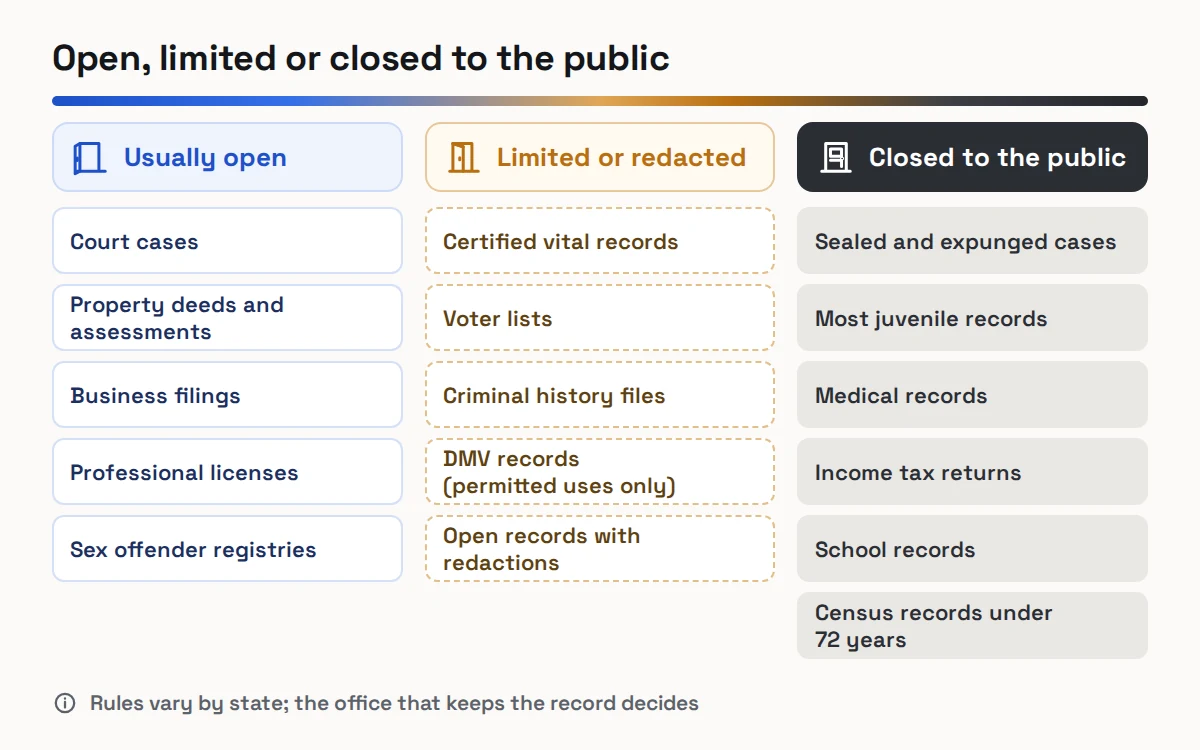
What information is public record depends on who keeps it. In general, public records are documents that government offices create or keep while doing public business, and much of what people look for is open to anyone: court cases, property deeds and tax assessments, business registrations, professional licenses, sex offender registries and, in many states, basic voter registration details. Other records are restricted or closed almost everywhere, including sealed and juvenile cases, medical records, tax returns and school records.
This guide shows how to look up public records or search them by name, the main types of public records, what isn’t public and where each record is kept, along with fees, redactions and how to be sure a record is about the person you mean.
Types of public records and where they’re kept
There’s no single national database of public records. Each type lives with the office that creates it, usually a county, a state agency or a federal court, and each office sets its own search tools, fees and rules.
| Record type | What it usually shows | Who keeps it | How to look it up |
|---|---|---|---|
| Court cases (civil, criminal, family, probate, bankruptcy) | Party names, case number, filings, hearing dates and the outcome | State courts and county clerks; federal courts for federal and bankruptcy cases | The court’s online case search or the clerk’s office; PACER for federal cases |
| Property records | Owner name, deeds, mortgages, liens and assessed value | County recorder or register of deeds; county assessor | County recorder and assessor websites, usually searchable by owner name or address |
| Vital records | Births, deaths, marriages and divorces | State vital records offices; some county offices | An application to the state where the event happened; certified copies are often limited to the person and close family |
| Business filings | Company name, formation date, status and registered agent | The secretary of state or a similar state office | The state’s business entity search |
| Professional and occupational licenses | License type, status, expiration and, in many states, discipline | State licensing boards | Each board’s license lookup, by name or license number |
| Voter registration | Name and address, and in many states party and voting history | County and state election offices | Varies by state; some release lists to anyone, others only to campaigns or parties |
| Criminal history | Arrests, charges and convictions | Courts for case files; state repositories and the FBI for rap sheets | Court case search for single cases; state repository rules vary; the FBI file needs the person’s own fingerprints |
| Sex offender registries | Registrant name, photo, address and offense | State, territory and tribal registries | Search by name or location at NSOPW.gov or on your state’s registry |
| Government agency records | Contracts, budgets, reports, emails and meeting minutes | The agency that created them | The agency’s website first, then a written request |
| Census records | Household members, ages and birthplaces | National Archives | Released after 72 years; 1950 is the latest census available |
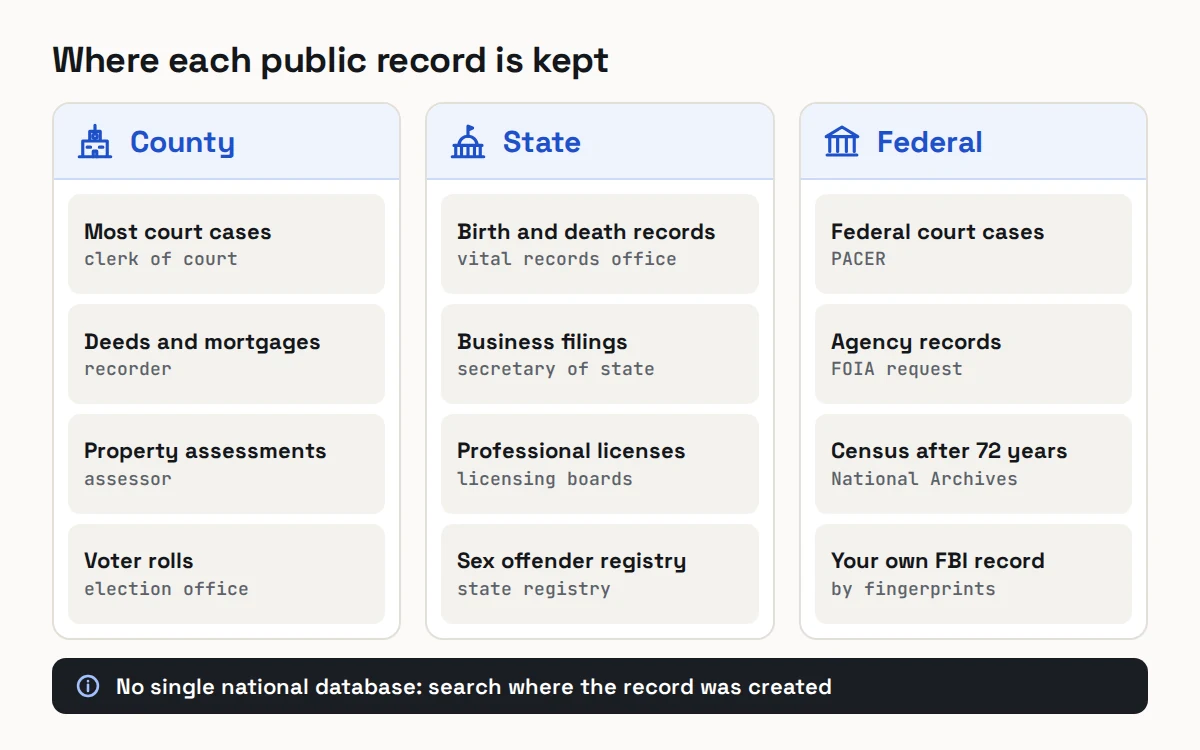
A few rows come with details worth knowing. The federal government doesn’t distribute vital records; you apply to the state where the birth, death, marriage or divorce took place. Voter list rules vary widely: according to NCSL’s 50-state summary, states commonly withhold Social Security and driver’s license numbers and full birth dates, and many bar commercial use of the lists. And the FBI’s national file, called an Identity History Summary, isn’t searchable by name: you request your own with a fingerprint card and an $18 fee.
What information is not public record
Public records laws come with exemptions, and other laws close specific records entirely. Expect these to be private or tightly restricted:
- Sealed, expunged and most juvenile court records. Once a court seals or expunges a case, it’s no longer open to the public, and juvenile cases are restricted in most states.
- Medical records. The HIPAA Privacy Rule limits who can see your health information held by doctors, clinics and health plans, and gives you the right to a copy of your own.
- Tax returns. The IRS’s Taxpayer Bill of Rights says information you give the IRS won’t be disclosed unless you or the law authorizes it. Property tax assessments are a different matter; those are usually public.
- School records. FERPA gives parents, and students once they turn 18 or start college, some control over who sees education records.
- Personal details in DMV records. The federal Driver’s Privacy Protection Act bars state motor vehicle departments from releasing personal information from driver and vehicle records except for specific permitted uses.
- Recent census responses. Individual census records stay closed for 72 years; the 1950 census was released in April 2022.
- Confidential parts of open records. Offices can black out protected details and release the rest. North Carolina’s courts, for example, explain that an agency may separate or redact the confidential parts of a record.
How to look up public records, step by step
- Name the record and the office that keeps it. Decide whether you need a court case, a deed, a license or something else, and which county, state or federal office would hold it. A person’s records usually sit where they lived, worked, owned property or were sued.
- Check what’s already online. Most courts, county recorders, secretaries of state and licensing boards run free lookups. FOIA.gov gives the same advice for federal records: look first for information that’s already public before you file a request.
- Search the office’s own system. Use the court’s case search, the recorder’s index, the state business search or the board’s license lookup. For federal cases, use PACER or the public terminals in the clerk’s office of the court where the case was filed.
- If it isn’t online, ask in writing. FOIA.gov says a federal request “simply must be in writing and reasonably describe the records you seek.” State and local offices follow their own law, and many have an online request form.
- Budget for fees and time. Looking is often free; copies cost money. PACER charges $0.10 a page, capped at $3 per document, waives fees if you spend $30 or less in a quarter, and makes court opinions free.
- Get a certified copy if you need to prove something. Courts, recorders and vital records offices issue certified copies for legal use; a printout from a website usually won’t do.

Before you send a request, have these ready:
- The office you’re asking and the law you’re asking under: FOIA for federal agencies, your state’s public records law for everything else
- A description of the record, with a date or date range
- Any case, parcel, license or file number you know
- The format you want, such as electronic copies
- The most you’re willing to pay before they contact you
- For records about someone else, their written permission or proof of death, if you have it
- Your name and the address or email where you want the reply
Sample wording for a public records request
“Under [the Freedom of Information Act / your state’s public records law], I request copies of [describe the records], dated [date range]. I prefer electronic copies. Please contact me before fees exceed $[amount]. If you withhold any part, please release the rest and tell me which exemption applies.”
FOIA and state public records laws
FOIA gives the public the right to request records from any federal agency, and generally any person, citizen or not, can file. Agencies must release what’s asked for unless one of nine exemptions applies, protecting interests such as personal privacy, national security and law enforcement. FOIA doesn’t require agencies to create records, do research or answer questions. If you want records about someone else, FOIA.gov notes that you’ll generally get more with that person’s written authorization or proof that they’ve died.
Records held by state, county and city offices fall under each state’s own law, called a public records act, an open records law or a sunshine law depending on the state. Deadlines, fees and exemptions differ. California’s Commission on Peace Officer Standards and Training, for example, notes that the 10-day period in the state’s law is not a deadline for producing records, while North Carolina gives any person the right to inspect public records and doesn’t allow charges for inspection, though copies can cost money. The Reporters Committee for Freedom of the Press keeps a state-by-state Open Government Guide with the rules for each state.
Courts work separately. Federal case files are on PACER, and state courts run their own portals and clerk’s offices. Our court records guide explains why a county search and a statewide one can disagree.
How to search public records by name
Most public indexes can be searched by name, but a name is a weak key. Court indexes rarely show a full date of birth, deeds list names exactly as they were typed, and the same name can turn up in several counties.
- Start broad, then narrow. Search the surname alone in a county index and read the list, then narrow it by first name, middle initial or date range.
- Try every version of the name. Maiden and married names, nicknames, hyphenated names and common misspellings all matter; our maiden name search guide covers name changes.
- Search where the person lived, worked or owned property, and check the neighboring county too.
- Use each registry’s own filters. NSOPW.gov searches state, territory and tribal sex offender registries by name and location, and licensing boards let you search by name or license number.
Before connecting a record to someone, read the original document and compare the dates, relevant identifiers and any contradictions. Two agreeing details may repeat the same record; they do not establish identity. A shared name alone is a lead, not a match. Our guide to verifying that a public record belongs to the right person walks through the method, and our guide to finding someone by name helps when a name is all you have.
Worked example: check who owns a rental before you pay
Say a listing offers an apartment below the going rate, and the “owner” wants a deposit before showing it to you. Property and business records let you test that claim.
- Look up the address on the county assessor’s or recorder’s website. The owner of record is listed by name.
- Compare names. If the owner is someone else or a company, ask how the person you’re talking to is connected. Property managers are common, and a real one can show a management agreement.
- If the owner is a company, look it up in the state’s business entity search to check that it exists, is active and names a registered agent.
- Look for foreclosure filings on the property, in the county court index or, in some states, among the notices recorded against the property, keeping namesakes in mind.
- Contact the owner or manager yourself, using a phone number or website you found on your own rather than the one in the listing.
The records can’t tell you whether the person messaging you is the owner; only the owner can confirm that. If the deposit request comes with pressure, a refusal to show the inside or a push to pay by app or wire, treat it as a scam. Our guide to avoiding marketplace scams covers the payment side.
Public records vs. people-search reports
People-search sites, Recordwell included, organize lawfully available records and open web information found under a name into one report. That can help you work out which county or state to check, and a careful report keeps people who share a name apart. It isn’t the original record, though. Coverage varies, a missing record doesn’t prove nothing exists, and the office that keeps a record is what settles anything important.
Recordwell isn’t a consumer reporting agency, so its reports can’t be used for employment, tenant screening, credit, insurance or other decisions covered by the FCRA. For those, use an FCRA-compliant screening service that gives the required notices; our page on people search vs. background checks explains the difference. Curious what’s out there about you? Checking yourself requires a plan for the full report; removing your own listing is free.
Common questions about public records
What information is public record in the US?
Generally, records that government offices create or keep while doing public business: court cases, property deeds and assessments, business filings, professional licenses, sex offender registries, many vital records with access limits and, in many states, voter registration details. Each state’s law sets the exact limits.
Are arrest records public?
Often, but it depends on the state and on how the case ended. Arrest information and court case files are frequently open, while sealed, expunged and juvenile records are not. An arrest is not a conviction, so read the court record for the outcome before drawing any conclusion.
Can anyone look up my address in public records?
Often, yes. Property records list owners by name, and some states release voter addresses. You generally can’t remove those from the office that keeps them, but you can opt out of people-search sites that republish them, and removing your own Recordwell listing is free.
How do I search public records by name for free?
Start with the free search tools run by the office that keeps the record: county court and recorder websites, your state’s business entity search, licensing board lookups and NSOPW.gov for sex offender registries. Looking is usually free; copies and certified documents may cost money.
Is a birth certificate public record?
Usually not in full. Birth records are kept by state vital records offices, and many states limit certified copies to the person named, close family or a legal representative. Rules vary, so check the application guidelines of the state where the birth took place.
Do I have to say why I want a public record?
Usually not. Generally any person can make a federal FOIA request, and state laws such as North Carolina’s give any person the right to inspect public records. Some records, such as certified vital records and voter lists, come with eligibility rules or limits on how you can use them.
Why can’t I find a record I know exists?
It may be sealed or expunged, filed in another county or court, indexed under a different spelling, too new to be posted, or available only in person. Search the surname alone, check neighboring counties, and call the clerk’s office if you still can’t find it.
Is a people-search report the same as a public record?
No. A people-search report organizes lawfully available records and open web information found under a name. It can point you to the right county or office, but the original record held by that office is what counts. For job, housing, credit or insurance decisions, use an FCRA-compliant screening service.