To find a long-lost family member, start with what your family already knows, then take the route that fits how you were separated. If you’re trying to find adopted siblings, begin with the formal channels. Those are the agency or court that handled the adoption, the state’s adoption reunion registry, and in some states a confidential intermediary who asks the other person before anything is shared. A DNA test, taken with your own consent and read carefully, can fill gaps the paperwork leaves. To find a half sibling, start with the parent you share. For a relative lost to distance or a family rift, a family map, a name search and a mutual relative usually get further than records do.
This guide is about finding adults. It isn’t a way to locate a child or to get around sealed records, and it doesn’t replace the police if someone may be missing or in danger. Reunion is a two-person decision, too. Finding someone and hearing that they want contact are different outcomes, and the second one is theirs.
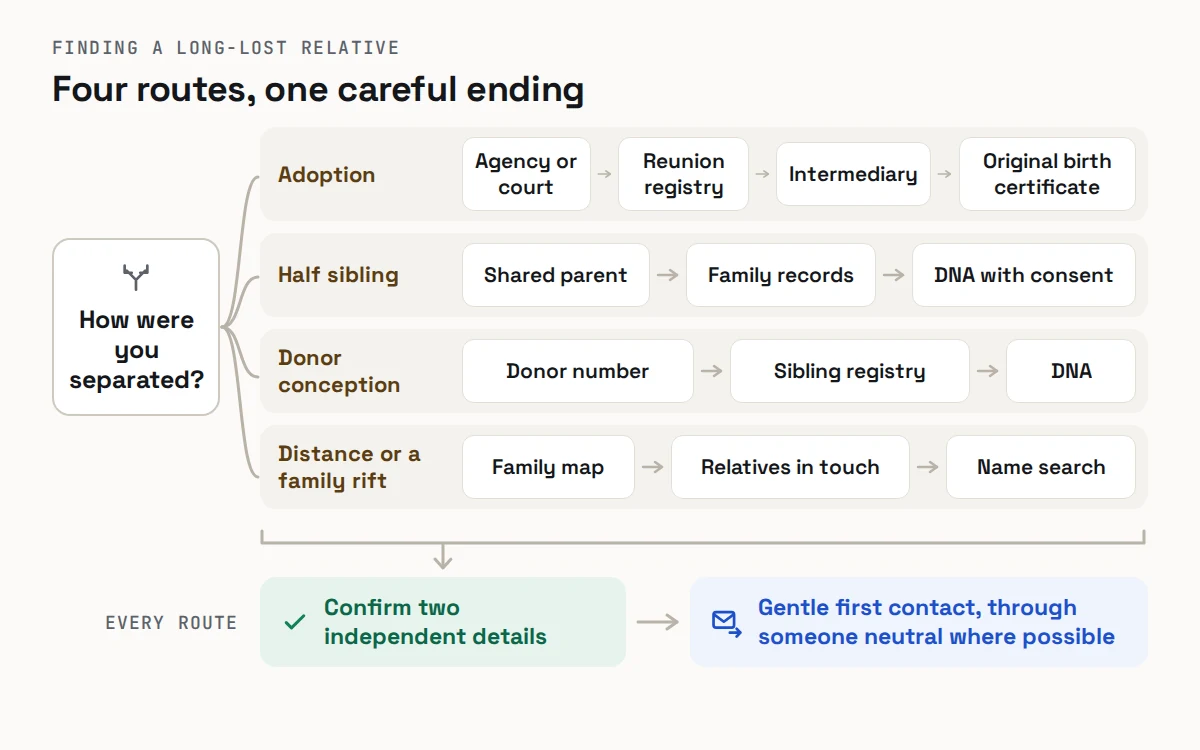
Choose your route by how you were separated
How you were separated decides where to start, which records you can use and who should make the first approach. Find the row that fits your situation.
| Your situation | Start here | Then try | First contact through |
|---|---|---|---|
| You were adopted and are looking for birth siblings | Your adoption papers and the agency or court that handled the adoption | Nonidentifying information, the state reunion registry, a confidential intermediary, your original birth certificate where the state allows it, then DNA | The registry, intermediary or agency, if one can make the approach |
| A sibling was placed for adoption, and you’re the one searching | Your parents and relatives, and any papers they kept | A registry that accepts birth siblings, a letter left with the placing agency, then DNA | The agency or an intermediary; your sibling may not know they were adopted |
| A half sibling through a parent you know | The shared parent, if they’re willing to talk | Obituaries, marriage and divorce records, probate files, then DNA to confirm | A letter or message, ideally after the shared parent has told them |
| A half sibling you only suspect | Family stories, photos and papers | DNA testing, read together with the family tree | The testing service’s messages, slowly |
| Donor-conceived half siblings | Your donor number and the clinic or sperm bank | Donor-sibling registries where both families opt in, then DNA | The registry or the testing service |
| A relative lost to divorce, a move or a family rift | A family map and the relatives still in touch | Older records for the family tree, current details for the living person, then a name search | A relative who knows you both, or one short message |
Build a family map before you search
Put everything the family knows on one page before you look anything up. Relatives remember different pieces, so talk to them one at a time. One may know the married name, another the town, a third the church where a baptism took place. Label each fact as documented, remembered or guessed, so a guess doesn’t quietly turn into a fact halfway through.
- Every name the person may have used: birth name, adoptive name, nicknames, married names, spellings in another language
- Date and place of birth, even if you only know the year and the county
- For an adoption: the agency, the court and county, the hospital, and the year it was finalized
- Parents’ names on both sides, and any relatives who might have stayed in touch
- Letters, photos with writing on the back, birth announcements, funeral programs
- Any nonidentifying information you’ve already received
- DNA results you or a relative already have, and which service holds them
- The last confirmed contact: who, when and where
For relatives from older generations, the National Archives’ guide to starting genealogy research points to census, military, immigration, naturalization and land records. Those records show who belonged to the family and where they were at a given date. Finding a living person means moving forward from there, through marriages, moves and later relatives. A married surname is often the missing link, and maiden name search shows how to follow one through marriage records and obituaries.
Keep the circle small while you work. The aim is to recover names, places and dates, not to reopen old arguments or spread someone else’s private history.
How to find adopted siblings: records, registries and intermediaries
In many adoptions finalized decades ago, the court record and the original birth certificate were sealed, and neither family was given identifying information about the other. Access has opened up since, unevenly, state by state. The Child Welfare Information Gateway summarizes each state’s laws on access to adoption records. Its factsheet on searching for birth relatives walks through the search itself. Four tools come up again and again.
Nonidentifying information. In nearly all states, an adult adoptee can ask, usually in writing, for the health, social and background history in the adoption file. It won’t name anyone, but it may mention other children in the birth family, their ages or where the family lived. Ask the agency that handled the adoption, or the state’s adoption office.
Mutual consent registries. Many states run an adoption reunion registry. It’s passive: as the Gateway’s factsheet explains, both people must register independently for a match to be made. Some registries accept adult birth siblings as well. Georgia’s Adoption Reunion Registry, for example, serves adult adoptees, birth parents and adult siblings. Register in the state where the adoption was finalized, and check each registry’s rules and fees before you apply.
Confidential intermediaries. In some states a judge can appoint an intermediary, such as the original agency or a professional searcher, to find a birth parent and ask whether they want to share information or meet. It’s slower than searching on your own. But the other person hears about you from someone neutral and can say yes or no in private. Ask whether the program in your state covers siblings too.
The original birth certificate. It names the birth mother and sometimes the father, which can lead you to siblings born before or after you. Whether you can get it depends on the state. Some let adult adoptees request it directly, and others require a court order. The CDC keeps a directory of state vital records offices.
If your sibling was the one placed for adoption, the same tools work from the other side. Register with the reunion registry in the state of the adoption, and ask the placing agency whether it will keep a letter from you on file in case your sibling ever asks. The person you’re looking for may not know they were adopted. That alone is a strong reason to let a registry, an intermediary or the agency make the first approach.
How to find a half sibling
A half sibling shares one parent with you, so the search runs through that parent. If the parent is alive and willing to help, that’s by far the quickest route: a name, a year, a town, and ideally their agreement to reach out first. If not, their paperwork may still hold the answer. Obituaries often list surviving children, including children from earlier relationships, and marriage, divorce and probate files can name former partners and children.
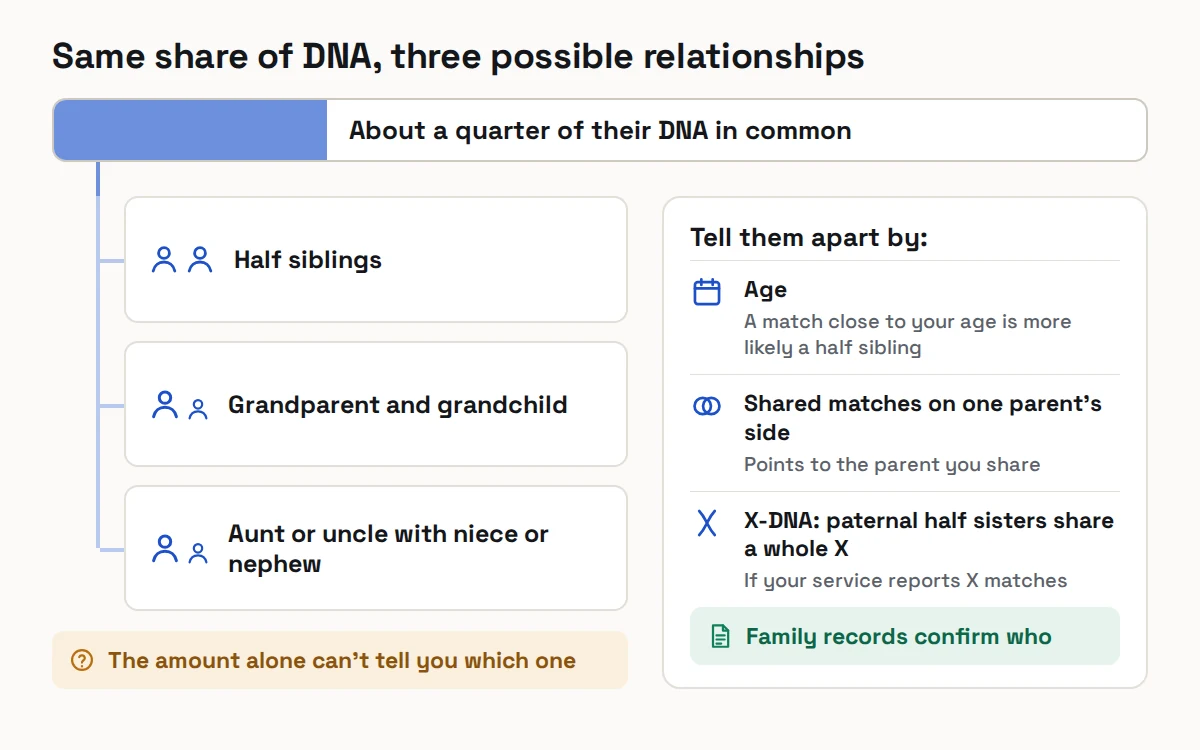
When nobody talks about a half sibling, DNA testing may be the only route, and the results need careful reading. Half siblings share about a quarter of their DNA, which is also the expected share between a grandparent and grandchild, or between an aunt or uncle and a niece or nephew. So the amount alone can’t tell you which relationship a match is. Age helps, because a match close to your age is more likely a half sibling than a grandparent. Shared matches help more. If the match also shares DNA with relatives on your father’s side and none on your mother’s, the parent you share is probably your father.
Some results add clues of their own. A father passes his single X chromosome to every daughter whole, so two women who share a father share that entire X. That shows up if your testing service reports X matches. Half brothers who share a father carry the same Y chromosome, though a Y-DNA match points to a paternal line rather than to one man.
If you were donor-conceived, start with your donor number. Clinics and sperm banks may run sibling registries, and independent donor-sibling registries let families who used the same donor find each other when both sign up. Consumer DNA tests can turn up half siblings who never registered, provided they’ve tested too.
Use DNA with consent
A consumer DNA test can confirm a relationship or reveal one nobody expected, and either result touches other people. MedlinePlus, the National Library of Medicine’s health site, notes that genetic privacy may be compromised if a company sells or shares genetic information or suffers a breach. It also notes that companies may be required to disclose genetic information to law enforcement, and that unexpected information about family relationships may be upsetting.
- Test your own DNA. Don’t send in a relative’s sample, or upload their results to another site, without their agreement.
- Read the service’s settings for relative matching and messaging before your results arrive, and decide what you want others to see.
- Treat a match as a relationship, not a name. The amount of shared DNA suggests how you’re related; family records confirm who.
- Don’t treat a match as an invitation. The other person may have tested for ancestry alone and never expected a new relative to write.
- Be ready for surprises about your own family, such as a different biological parent than the one you were told about.
Confirm the person before anyone makes contact
Registries, intermediaries and DNA matches often end with a name. Before a message goes out, make sure that name belongs to the person you mean. Recordwell searches by first and last name. It brings together lawfully available records and open web information found under that name: places connected to it over time, matters filed publicly, business registrations and professional licenses, and publicly visible profiles and mentions. People who share the name are kept apart.
A candidate counts as confirmed only when at least two independent details agree. That could be a birth year from the adoption papers plus a city, or a city plus the name of a parent. Recordwell withholds records about people known to be minors, and it doesn’t provide phone numbers or email addresses. If the details don’t line up, leave the result unresolved. Coverage varies, and a missing record isn’t proof that the person can’t be found. Matching a record to the right person explains which details count as independent, and people search covers narrowing a common name. For spelling variants and nicknames, see finding someone by name.
Worked example: confirming a half brother
Your father’s 2019 obituary lists “a son, Daniel Reyes, of Phoenix,” a name you never heard at home. Your DNA results show a match in the half-sibling range who also matches your father’s cousins and nobody on your mother’s side. The account is labeled only “D. Reyes.”
A name search for Daniel Reyes returns several people. One is the right age to be your father’s son, has lived in Phoenix since 2006, and was connected to Fresno, your father’s city, before that. Another lives in Phoenix but is in his twenties. The obituary gives the name, the DNA match confirms a half brother on your father’s side, and the right age plus the Fresno years single out the first candidate. Those details come from different places and don’t depend on each other.
The next step is a short note through the testing service’s messages, not a phone call or a visit. He may already know about you, or he may not.
Get ready before you reach out
According to the Gateway’s factsheet, adoption professionals strongly recommend emotional preparation before a search, including reading about other people’s search and reunion experiences and talking with others. The advice holds for any long-lost relative. A reunion can bring relief, grief, awkwardness and old family history into the open all at once, for both of you.
- You know what you’re hoping for: a relationship, one conversation, medical history, or just knowing they’re alive
- You’ve thought about what you’ll do if they say no, or never answer
- You have support lined up: a friend, a search and reunion group, or a counselor
- You’re prepared for facts that change your family story
- You’ve decided what you will and won’t say in a first message
First contact: gentle, private and easy to decline
If a registry, an intermediary or an agency can make the approach, let it. The other person hears the news from someone neutral, has time to think, and can say no without facing you. Otherwise, choose the least intrusive route you have: a relative who knows you both and asks permission first, a message through the DNA service, or a letter. Don’t turn up at their door, and don’t go through their partner, children or employer.
Keep the first message short, and save the family history for later:
Hello [first name]. My name is [your full name]. I believe we may be related; I think we share [a birth mother / a father, and his name]. I’d welcome the chance to be in touch if you would too. I’m happy to explain how I came to this and to answer any questions first, and I understand if now isn’t the right time. You can reach me at [one contact method].
Leave out anything the person may not know, or may not want others to know: the circumstances of an adoption, a parent’s affair, medical details, old disputes. If there’s no reply, one gentle follow-up after a few weeks is enough. After that, take the silence as their answer.
When not to reach out, and when to get help
Stop, or hand the search to a professional, if any of these apply:
- A protective or no-contact order involves you and the person, in either direction.
- They, or an intermediary on their behalf, have already said no, or they’ve registered a refusal with a registry.
- The person is under 18. Contact with a child goes through their parents or the agency that handled the adoption, never directly.
- There’s a history of abuse or violence in the family, or someone may be staying hidden for their own safety.
- You think someone is missing rather than out of touch. Call the local police; NamUs is the national clearinghouse for missing and unidentified person cases.
International adoptions, sealed records you want opened, and anything involving guardianship or a court case are good reasons to bring in a professional. That could be an agency’s post-adoption service, a court-appointed intermediary, a social worker or an attorney. Before you pay a private searcher, ask what they can lawfully access, what exactly they’ll deliver, and whether they would contact the person without checking with you first. Be wary of anyone who promises a reunion.
Repeated contact after someone has declined isn’t persistence. Under the Justice Department’s definition, stalking is conduct directed at a specific person that would leave a reasonable person afraid for their safety or in substantial emotional distress. Looking someone up for a personal reason is ordinarily lawful; is people search legal explains where the limits are. If the person you want to find is an old friend rather than a relative, finding an old friend covers that search. And if you’re the one who would rather not be found, a full report for a self-check on Recordwell requires a plan; removing your information is free.
Frequently asked questions
How do I find adopted siblings?
Start with the agency or court that handled the adoption and request your nonidentifying information, which may mention other children in the birth family. Register with the adoption reunion registry in the state where the adoption was finalized, since some registries accept adult siblings, and ask whether that state offers a confidential intermediary. A DNA test can find siblings who have tested too.
How can I find a half sibling I’ve never met?
Begin with the parent you share, or with that parent’s records if they have died. Obituaries often list surviving children, and marriage, divorce and probate files can name earlier families. A DNA test can confirm the relationship if your half sibling has tested, but a match at that level could also be a grandparent, aunt or uncle, so compare ages and shared matches.
Can adopted adults get their original birth certificate?
It depends on the state. Some let adult adoptees request the original birth certificate directly, and others require a court order. The Child Welfare Information Gateway summarizes each state’s rules on access to adoption records, and the state vital records office can tell you its current process.
Can a birth sibling register with an adoption reunion registry?
In some states, yes. Georgia’s registry, for example, serves adult adoptees, birth parents and adult siblings. Registries work on mutual consent, so a match happens only when both people have registered. Check the rules of the registry in the state where the adoption was finalized.
Should I take a DNA test to find a lost sibling?
It can help, especially when records are closed. Test only your own DNA, and read the service’s matching, messaging and privacy settings before your results arrive. A match suggests a relationship, and records confirm it. Results can also reveal things about your own family that you didn’t expect.
Can a people search find a long-lost family member?
It can help once you have a full name. Recordwell searches by first and last name, keeps people who share a name apart, and treats a match as confirmed only when two independent details agree. It doesn’t provide phone numbers or email addresses, and it withholds records about known minors.
What if my relative doesn’t want contact?
Respect it. One gentle follow-up is reasonable if your message might have been missed. After that, stop. Don’t contact their family, friends or employer, and don’t post about them. If you leave your registry entry in place, they can still find you if they ever change their mind.
How can I find a long-lost family member for free?
Much of the work costs nothing: talking to relatives, building a family map, reading obituaries and online family trees, and asking a relative in touch with both sides to pass on a message. State registries set their own fees, and certified records, DNA tests and professional searchers usually cost money.